Monday, June 9, 2014

Henry Kravis as Godzilla and Katsumoto


His name is synonymous with 'Corporate Titan.' As co-founder of KKR, Henry Kravis re-wrote the rules of leveraged buyouts; he and his cousin George Roberts now rule over an empire that dwarfs some of the world's mightiest public corporations. "Bloomberg Game Changers" follows Kravis' rise from his early days in 'bootstrap' acquisitions, through his role in the 1988 landmark LBO of RJR-Nabisco, to KKR's IPO on the New York Stock Exchange.
It was about using Wall Street in a new way, mobilizing capital to go into companies, and building them into even stronger companies.  Henry Kravis' idea was to work with the existing management and to sell off companies assets to boost profits quickly.  But it was clear he had no patience for anyone who didn't cooperate, and he went to war against anyone who dared defeat him.  
He was not just big guns coming in, it was Godzilla wading in from the ocean and stomping down Wall Street.
The story?  RJR-Nabisco was Kravis' LBO target in 1987, especially because CEO Ross Johnson was willing to listen to anything that would bring his company and himself a fortune.  The plan, broadly speaking, was to sell its bloated food division and keep the cash cow cigarette division (Winston and Camel).  Kravis saw this as the blockbuster deal that he craved in a decade of increasing desire for more: greed is good.  

Except that Johnson wanted to engineer the LBO himself.  In partnership with Shearson Lehman Hutton, which had no experience in such deal making.  Hmm, what was he thinking?  Kravis was outraged.  He must've had no idea how much of a blockbuster RJR-Nabisco was to become, as he and Johnson squared off - Godzilla vs King Kong.  The two spiked the value of RJR-Nabisco up, which on graph looked like the dizzying vertical surface of El Capitan.
Henry Kravis has constantly pushed the envelope. He's helped define the private equity industry.
The Board of RJR-Nabisco demured, when Kravis raised its initial offer and even as its own insider upped the ante.  But eventually the Wall Street Tycoon (aka Godzilla) won the day.  Or did he?  The war with Johnson must've been a Pyrrhic Victory, as the cash cow didn't turn out to be as much of a cash cow going into the 1990s.  By the middle of that decade, there was such social backlash on smoking that Kravis had to rid the firm of the once-coveted prize of the RJR-Nabisco LBO.
Henry was ahead of everybody, when it came to raising money. He sort of invented the business.
This biography could've easily taken hours. Kravis may have been as calculating and fierce, as steely and brilliant as Katsumoto in `The Last Samurai.  But both character and tycoon were only human after all.  I'd want to know how Kravis rethought his dealmaking approach as the last decade rolled in.  The handsome Jewish man is 70 now, but we'd be forgiven for thinking he was much older.  Katsumoto died proudly in the field of battle, so will Kravis, I'm sure, when his time comes.  

Henry Kravis
Thank you for reading, and let me know what you think!

Ron Villejo, PhD

Friday, June 6, 2014

Shaq as the Terminator and Bambi of Fun


The NBA legend is on the road to being a billionaire.
Actor.  Rapper.  Entrepreneur.   Analyst.  Comedian.  Designer.  Doctor.  Shaquille O'Neal has more than just parlayed his basketball super-stardom into business success.  He has positioned his innate talent to blossom in truly multiple ways.  It's one thing to wear different hats, for example, but it's another thing to have a keen mind inside the head that wears those hats.
General Eisenhower said, "The greatest of leaders are the ones smart enough to hire people smarter than them."
 Besides this crucial lesson learned, O'Neal took it upon himself to think about his post-basketball years, well before his actual retirement.  Of course, it helped that his mother often prompted him in this vein.  Tennis superstar Maria Sharapova understands that very well, too.

But back to that Eisenhower lesson, not many leaders, I think, are secure or confident enough to surround themselves with staff who know more than they.  That is inevitably their fatal flaw.  Instead of advancing knowledge and skills, so crucial for innovation and execution, they erect direct and indirect roadblocks.  My colleagues and I call them "bottlenecks," like roadways that narrow traffic from two lanes into one lane.

I am also intrigued by how Perry Rogers and Colin Smeeton conceived of Shaq Inc.  The stunning looker of a model on Sports Illustrated a couple of decades ago - Kathy Ireland - was on the cover of Forbes one time, and the two PR men were stunned at the thousands of products she had on offer and the millions in revenue that she raked in.  She was the voice of busy Moms, and her messages spoke to them.

So what was Shaq's message, and more importantly to whom?  Rogers and Smeeton saw that he didn't just appeal to one segment, but to wide range of segments, for example for ages 9 to 90.  But regardless, his message was fun.  They carved a business around fun, which meant that they weren't just chasing after endorsements (i.e., reactively) but that they were in a position to command deals and partnerships (i.e., proactively).

It was evident that Rogers and Smeeton didn't have an overnight insight into Shaq Inc.  Rather, it took a lot of conversation between them and a lot of thinking, weighing and trying things out.  This is an important lesson for CEOs and their pursuit of innovation, growth and success.
It's a touchable brand.  It's a brand that people can relate to. 
I'm the Terminator on the outside, Bambi on the inside.
It's appealing quotable stuff like that really he's been spouting off throughout his breathtaking basketball career.

Thank you for reading, and let me know what you think!

Ron Villejo, PhD

Wednesday, June 4, 2014

Larry Ellison a Must Case Study for CEOs


BLOOMBERG GAME CHANGERS follows Larry Ellison from his early days in Chicago through the founding of the multibillion-dollar software company to his rise as the highest paid executive of the last decade with a total compensation of $1.84 billion.
If you've interacted with any government, bought anything online, called a mobile phone, and paid with a credit card, you've probably encountered an Oracle product.  Oracle is both hardware and software for the management of database, customer relationships, and supply chain.

Rebellious, unconventional, and whip smart, Larry Ellison worked technical colleagues and business customers alike.  He and Steve Jobs were different personalities, in specifics that were no doubt more evident in their private lives than to the public eye, but they must've been alike in their tenacity, determination, and boldness.
He's the Samurai Warrior of Silicon Valley.  Larry's attitude is: If you want to compete against me, then be prepared to get crushed.
While he took the high road vis-a-vis Bill Gates and Microsoft, during a 1996 appearance on the Charlie Rose Show, Ellison was evidently not immune to going underhanded.  It was well-said that Oracle needed to beat Microsoft by making a better product, but he apparently took to a private detective to dig up dirt on Gates, too.
He sees around the corner, well before many of us get to the end of the street.
The idea behind the Network Computer, to my eyes, foresaw tablets by 10 years.  Although Apple would probably never admit to it, the NC predated the iPad.  You could surf the net and send e-mails with it, in a far user-friendly way, than what?  Not just Windows 95, but also Apple itself and other computer makers.  Ellison remobilized a company, that must've become complacent as the 1980s ended, and he brought it back to high respectability by the mid-1990s.
Larry Ellison is pretty similar to the New York Yankees. They're the team you love to hate, and as a competitor to Larry Ellison, I'm sure he's the person that people love to hate, given how successful he's been.  
In this biography, Ellison is a breathtaking case study.  Whether or not he is someone whom a particular CEO ought to emulate is not for me to say.  But I do recommend watching this video, if only to prompt reflections on what the CEO needs to be, in order to do his or her work effectively, and ultimately hit critical targets.  Lessons learned must be mulled over, not adopted blindly or swallowed whole.  Only then can these lessons have usefulness, even meaning, for the CEO.
  
Thank you for reading, and let me know what you think!

Ron Villejo, PhD

Monday, June 2, 2014

Jon Stewart Acts the Shakespearean Fool


BLOOMBERG GAME CHANGERS profiles Jonathan Stuart Leibowitz, now Jon Stewart, from his New Jersey boyhood through the standard struggle of the stand-up comedian - part time jobs and late night gigs at New York's comedy clubs. It will shine a spotlight on his early television shows and movies, including rare video from his early career, to show his transformation into the dominant American commentator of our time.
So explains comedian Jon Stewart:
Our show obviously is at a disadvantage, compared to the many other news sources, that we are competing with.  For one thing, we're fake. 
Bill Grundfest, writer and producer, at the Comedy Cellar tells the story of Stewart's first appearance on Open Mike night.  He was getting nothing, he was bombing, he was dying.  But Grundfest saw that he had a point of view.  He was not afraid or self conscious, and had no contempt for the audience.  So what did he do with the young comic who bombed?  He brought him back.

Stewart seemed to have been the whipping boy of failure in the tough, early years.  Market segment, after market segment, just didn't seem to take a liking to him.  But in the process, he clearly impressed influential figures, like David Letterman, and media executives like Grundfest.
I'm a tiny, neurotic man, standing in the back of the room, throwing tomatos at the chalkboard.  That's really it.
In certain plays, like `King Lear, Shakespeare deployed a Fool, who was smart and witty and plugged-in to what was going on.  Moreover, he had license to talk frankly with the King.  In `Henry IV, Part 1, it was the tavern avoirdupois Falstaff as the Fool to Prince Hal who frequented that tavern world.  Stewart is that Fool, to me.  He has a purpose for us, and society at large, which very few others have liberty to possess or courage to speak to.

Stewart is a cultural, a political, and evidently a business force, too.  These forces converged like the gravity notions of both Newton and Einstein to finally win that coveted market following, on top of executive acclaim.  He was voted fourth most admired journalist, and he's not even a journalist.  Go figure.  He had a knack for criticizing journalism, in the process, while appealing effectively to the journalists behind his criticism.

Fellow comedian Ricky Gervais apparently isn't on the Jon Stewart bandwagon, though:
He's not as smart as me, though.  He's not really as handsome, either.  And he's not as funny as me.  
Go figure.

Thank you for reading, and let me know what you think!

Ron Villejo, PhD

Friday, May 30, 2014

Rangers Henrik Lundqvist in Sport and Fashion


New York Rangers goalie Henrik Lundqvist has been absolutely beastly on net, in this year's Stanley Cup playoffs.  The Montreal Canadiens, their opponent in the Eastern Conference Final, lost Game 2, not so much because of the absence of their injury starting goalie, as it was the presence of the Rangers' starting goalie.  King Henrik, as he is respectfully known, & Co. absolutely stoned the high-flying, high-pressure Canadiens.  Enjoy the highlight reel above.


But here we are talking fashion.  Because their ubiquitous profile in the media, athletes really have loads of opportunity to present themselves creatively and fashionably.  Fans don't often see who they really are and what they really look like, underneath a mountain of gear or in the swirl of their sport.  

Miami Heat superstars Dwayne Wade and LeBron James are a fashion contrast
Henrik Lundqvist's sense of fashion fits my style better

So off the ice, Lundqvist is in perfect position to showcase his handsome looks and easygoing style, which I imagine the guys want to emulate and the ladies want to be with.  

I am often glad to see athletes get into business, while they're still in the midst of their sports.  What they do has such a brutal, wearying impact on their body, that 30s is old and a prompt for retirement.  In fact it was early this year we saw Bread & Boxers Announces Partnership with Henrik Lundqvist.  I imagine the King has positioned himself in good stead for that inevitable transition to retirement.

Thank you for reading, and let me know what you think!

Ron Villejo, PhD

Wednesday, May 28, 2014

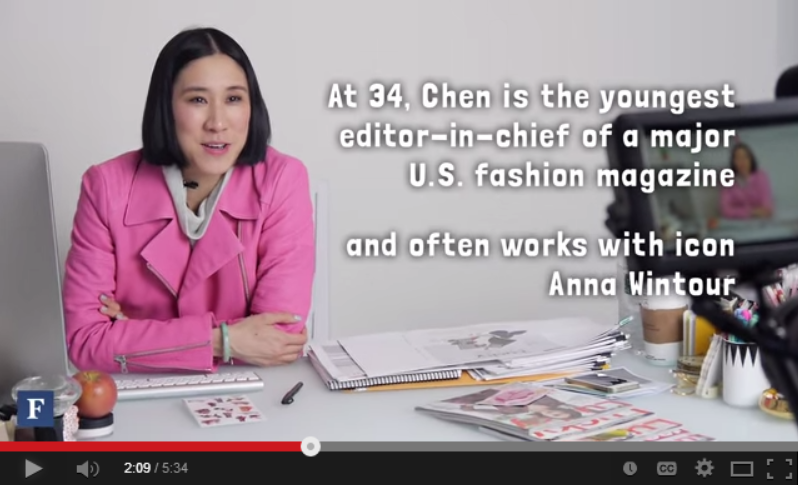
Editor-in-Chief Eva Chen Speaks Lucky Fashion


Eva Chen is attractive and articulate in a relaxed, natural way.  Her sense of style doesn't overpower you, but instead makes you feel like she's a friend you'd have lunch or coffee with.  She's bucked the trend of young Asians going into engineering, law, finance or medicine, and happened upon a job and a career that is clearly something she delights in.  

Lucky
Eva Chen

Chen is noteworthy for her editorial youth in fashion magazine, but she's actually on the older edge of the coveted Millennial group that Lucky Magazine targets.  Her personality must be as colorful, spirited and fashionable as her profiles on social media.

Twitter
Tumblr
Instagram

Chen certainly has a pulse on her target audience, those 20- and 30-somethings, and works at being empowering, rather than imposing, and no doubt shops, wears and shares fashion in ways that resonate with her readers.

Thank you for reading, and let me know what you think!

Ron Villejo, PhD

Monday, May 26, 2014

CMO Marc Speichert Speaks L'Oreal Marketing


Chief Marketing Officer Marc Speichert suggests that to complement an already well-structured, well-executed product innovation, L'Oreal has worked to refresh its go-to-market strategy and efforts.  Media and digital are clearly on his mind, given the four billion Google searches a year on beauty alone.  

YouTube ventures forthrightly into downtown Chicago

In this regard, Michelle Phan is a nature choice for L'Oreal to partner with.  I took a photo of this glossy poster of her, as there is now a concerted effort to raise her online virality to another level.
Beauty continues to be a growing area of content on YouTube, and brands like L'Oreal are tapping into this online community. More than 120 million how-to and beauty videos are watched every day on YouTube, and makeup videos are now the most searched for how-to content on YouTube.

According to Google research, 50 percent of all beauty shoppers watch a beauty video on YouTube while they are shopping for products – that's 1 out of every 2 people shopping for beauty products.
Reference: L'Oreal Launches New Makeup Line Designed by YouTube Beauty Guru Michelle Phan.

Image
The `Path to Purchase is about demarcating and perpetuating the purchase process

Speichert also spoke about `Path to Purchase.  It's building enough awareness, if it isn't there already, so consumers can consider what L'Oreal has to offer.  Besides the active viewing they do online, they talk with their beauticians and stylists, and no doubt their friends, too.  In the best case scenario, not only does an evaluation lead to a purchase, but also the overall experience prompts consumers to keep buying L'Oreal and talking it up themselves.
The product consideration phase is serious because the consumer is discovering something new or making a connection. People spend a lot of time in the consideration phase engaging their stylist, media sources and their friends moving them from being interested to a desire to try the product “evaluation”.

The extensive evaluation process is one of L’Oreal’s key focus points since people are searching for pier to pier recommendations, prompting them to buy. Evaluation is a very collaborative process and also involves more content discovery. The buy side is not the end of the cycle, it’s only the beginning. The next stage is creating brand advocates that have an emotional connection. A carefully nurtured evangelist is required to spread out the target brand’s DNA to the salons and the consumers. Using an authentic tone and voice will perpetuate the organic reach and referrals that can last a lifetime.
Reference: How L’Oreal Tracks the Consumer Path to Purchase.

Registered on July 31st 1919 in France, L'Oreal has had nearly 100 years to build itself up as the largest cosmetics company in the world.

Numbers in brief

Consolidated Sales

Operating Profit

Stock Performance

Topline and bottomline numbers are steady in growth, and while investor confidence has level off since a year ago, L'Oreal is not far off its 52-year high (€137.65) with its current stock performance (€128.10).  That's beautiful in both literal and financial languages.

Thank you for reading, and let me know what you think!

Ron Villejo, PhD